Since Corp Fin recently renamed the CDIs to “CFIs” – “Corporation Finance Interpretations” to the “Compliance and Disclosure Interpretations” – I thought it would be a good time to recount the long history (50 years!) of this source of informal staff guidance. Here are nine things to know:
- One of many informal sources of guidance: I’d like to start by reminding folks that if you are new to this field, it can be confusing to understand all the different places you need to check for staff guidance as there can be as many as a dozen sources of guidance. The popularity for a few of these sources wane over time – sometimes they do make a comeback – as new leaders of the staff come and go and change the avenues by which they deliver guidance to interested parties.
- Before the “Phone Interps”: As noted in this recollection from John Huber, who served as Corp Fin’s Director in the mid ‘80s, the birth of what became known as the “Phone Interps” originated in Corp Fin’s Office of Chief Counsel in response to questions asked by companies and their counsel. This was a gradual and informal process that happened organically.
- The “Phone Interps”: I’ll pick up from John’s recollection by harkening back to the beginning of my career when CFIs existed in the form of a “Telephone Interpretation Manual,” often called the “Phone Interps.”
We’re talking 1988 so this document was in paper – and it was for the staff’s eyes only. It was not publicly available – however, the positions in the Manual were not necessarily confidential because if you lobbed in a question to Corp Fin’s Office of Chief Counsel by phone, a staffer might refer to an answer located in the Manual.
It served as an internal SEC resource to try to get all of the Staffers on the same page. Over time, the Manual grew by having “Supplements” periodically come out – typically tailored to address the questions that arose from new rulemakings. There were a total of five supplements (March 1999, March 2000, July 2000, October 2000 and September 2004; here’s what the first supplement looked like). - Started solely as an internal Corp Fin resource: During this period, when someone left the Staff to go work in private practice, they took a copy of the latest version of the “Telephone Interpretation Manual” with them. I say “latest version” but the Manual was very rarely updated. Even when the Manual was finally made public, it was rarely updated for the first decade or so. This blog that I wrote in 2005 indicated that the Manual was getting its first refresh in nearly a decade.
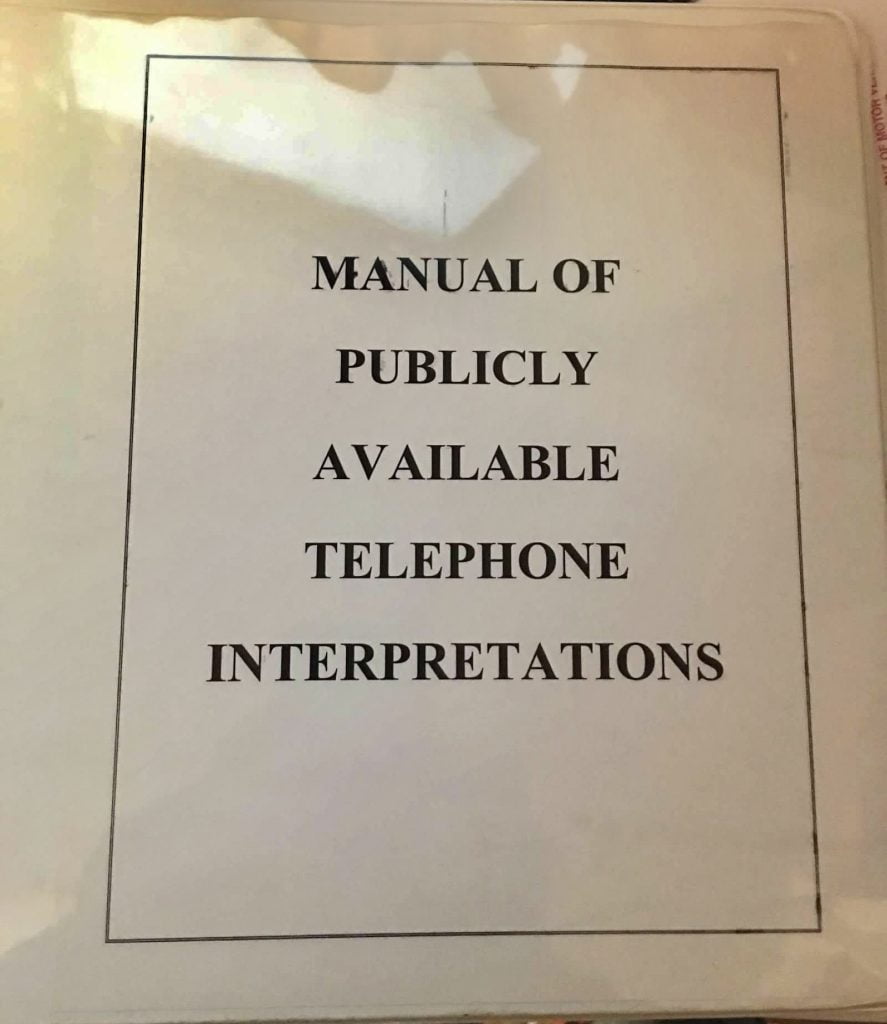
During these early days, the Manual was in the form of a three-ring binder, which was updated periodically with a notation sheet in the front telling you which sections had been updated. Below is an image of what this binder looked like. - Phone Interps made publicly available in early 1990s: At some point in the early 1990s, the Phone Interps were made publicly available, partially in response to numerous FOIA requests for it. The Phone Interps were available solely behind the front desk in the Public Reference Room – they were not available online (as “online” didn’t exist yet) or even in the SEC’s library.
- Phone Interps posted on the SEC’s website: The SEC launched its first website in September 1995, a big deal because Edgar filings then became much more easily accessible (here’s what the SEC’s home page looked like in ’97). The SEC’s site in those days was fairly rudimentary – like most sites – and there were no separate web pages for each Division like there is today.
A few years later – in January 1997 – the Phone Interps were first publicly made available in a PDF format with 186 pages (or more depending on how it was downloaded) and approximately a thousand interpretations. The interps had no numbering. The Manual was located under a tab called “Current Rulemaking” which you then had to go to “Other Commission Notices and Information” to find it.
Getting access to the SEC’s resources online was a big deal because folks had to pay service providers that specialized in obtaining documents from the SEC’s Public Reference Room in DC to obtain the most basic of items. For example, in 1988, it cost around $130 to have a Form 10-K delivered to New York the following day (back when $130 was $130) – and the SEC’s proposing release for Rule 144A cost around $200. Wild. I’m not quite sure when the Phone Interps were posted online.
I believe in those early years, the Manual was posted in different ways including as a single PDF, separated into distinct PDFs and then eventually, the Phone Interps were coded in HTML with an index – so that the Manual looked like this back then. It was challenging to search through some of these permutations as word searches weren’t possible. - Phone Interps renamed the “CDIs” in 2007: In 2007, the Phone Interps were renamed as the “Compliance and Disclosure Interpretations” – and it took a few years to completely phase out the Phone Interps to CDIs, with the Phone Interp supplements being the last to be integrated into the CDIs.
This wasn’t just a renaming project. A new numbering framework emerged as each CDI section was broken down into two parts: Questions and Answers of General Applicability and Interpretive Responses Regarding Particular Situations. A date was affixed at the end of each interp to indicate that last time it was published or revised. This new framework was very useful to navigate what was a lengthy set of interps. - CDIs updated more frequently: And then, going forward the CDIs were updated more frequently – sometimes more frequently than others. But none as frequently as what the current Corp Fin has been doing, as they’ve been on a tear over the past year revising and deleting old interps and issuing new interps.
- CDIs renamed the “CFIs” in 2026: And as I recently blogged, Corp Fin just renamed the CDIs as the “Corporation Finance Interpretations.”
Hat tip to Phil Brown, the former CEO of Intelligize and Tina Fukunaga, a retired SEC librarian – as well as former Corp Fin Director John Huber (see this blog for some of his gloss) – for their help to bring back the memories…
Authored by

Broc Romanek